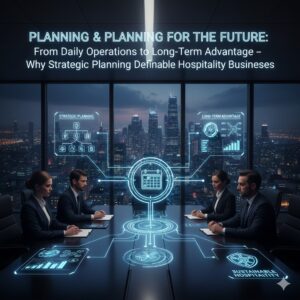
Planning & Planning for the Future From Daily Operations to Long-Term Advantage Why Strategic Planning Defines Sustainable Hospitality Businesses
- December 26, 2025
- F&B Service Operation, Marketing, Restaurant Management
- 3 mins read
By Charles Tan , President /FBMA Thailand
Modern Hospitality & Restaurant Advisory
Introduction: Success Today Does Not Guarantee Survival Tomorrow
Many hotels and restaurants are still operating on instinct, experience,
and short-term financial planning.
While this may have worked in the past,
today’s environment is fundamentally different.
Labour costs are rising.
Guest behaviour is changing rapidly.
Technology is replacing traditional roles.
Competition is no longer local—it is global.
In this reality, planning is no longer an administrative task.
It is a strategic capability that determines whether a business survives, scales, or slowly declines.
- Redefining Planning in Modern Hospitality
Traditional Planning
- Annual budgets based on assumptions
- Revenue targets driven by optimism
- Staffing plans based on headcount
- Reactive problem-solving
Modern Strategic Planning
- Plans grounded in operational reality
- Data-driven decision-making
- Multi-year visibility (3–5 years)
- Built-in flexibility and contingency
Strong planning does not make businesses grow faster—
it prevents them from failing unexpectedly.
- Core Planning Pillars for Hotels and Restaurants
2.1 Business Planning: Aligning Vision with Reality
Key executive questions:
- Who is the real target guest today—and in the future?
- Where does revenue truly come from?
- Which costs are controllable, and which are not?
Effective business planning:
- Avoids over-optimistic forecasts
- Includes best-case, base-case, and downside scenarios
- Aligns concept, capacity, and market demand
2.2 Operational Planning: Designing for Execution
Many hospitality businesses fail not because of poor ideas,
but because their plans cannot be executed on the floor.
Modern operational planning focuses on:
- Peak hour and peak season readiness
- Identifying operational bottlenecks
- Reducing reliance on “star performers”
- Designing systems that new staff can run confidently
If a plan only works with exceptional people, it is not scalable.
2.3 Financial Planning: Managing Cash, Not Just Profit
Modern financial planning prioritises liquidity and resilience.
Key principles:
- Revenue broken down by real channels
- Cash flow visibility over accounting profit
- Labour costs projected forward—not frozen in today’s numbers
- Contingency reserves built into the plan
Businesses do not fail because they are unprofitable—
they fail because they run out of cash.
- Planning for the Future: Preparing for Uncertainty
3.1 People Planning: Fewer People, Stronger Systems
The future of hospitality is not about finding more staff,
but about reducing dependency on individuals.
Forward-looking people planning includes:
- Leaner teams supported by clear processes
- Short, effective training cycles
- Design and layout that reduce physical and cognitive load
- Succession planning for critical roles
3.2 Technology Planning: Technology as Cost Control
Technology is no longer optional—it is a structural tool.
Examples include:
- Mobile and self check-in
- QR-based ordering systems
- POS-integrated inventory control
- OTA, CRM, and guest data analytics
Technology delivers value only when planned from the beginning,
not when added as a quick fix.
3.3 Flexibility Planning: Designing for Change
Future-ready businesses are built to adapt.
This requires:
- Flexible concepts and pricing models
- Spaces that can be reconfigured
- Teams that can be restructured quickly
- Contracts and cost structures that allow adjustment
Rigid planning is one of the highest risks in modern hospitality.
- Common Planning Failures We See Repeatedly
❌ Planning based on hope rather than data
❌ Revenue plans without cost strategies
❌ Opening plans without sustainability plans
❌ No contingency or downside scenario
❌ Delaying decisions until problems become critical
- The Vigor Hotel Solutions Planning Philosophy
At Vigor Hotel Solutions, every engagement starts with the same questions:
- What happens if revenue underperforms by 20–30%?
- Can the operation survive sudden staff shortages?
- Where can costs be adjusted without damaging the brand?
- How quickly can the business scale—or contract—if needed?
If a plan cannot answer these questions,
it is not ready for investment or growth.
Conclusion: Planning Is the Most Valuable Investment
The most resilient hotels and restaurants are not the most aggressive,
but the most prepared.
Planning and Planning for the Future
is not paperwork—it is leadership.
You may not need your plan every day.
But the day you need it, there is no time to create one.