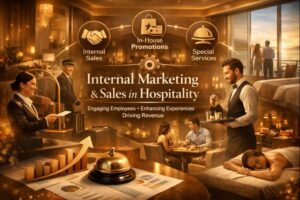
Internal Marketing and Sales in Hospitality Turning People, Processes, and Places into Revenue Engines
- December 30, 2025
- Marketing, Restaurant Management
- 3 mins read
Thought Leadership by Charles Tan/FBMA Thailand
In today’s hospitality landscape, marketing and sales are no longer confined to advertising campaigns, digital channels, or sales offices.
The most powerful—and often most overlooked—source of revenue growth lies inside the organisation itself.
Internal Marketing and Internal Sales transform employees, spaces, and daily interactions into a coordinated system that consistently creates value, drives incremental revenue, and strengthens guest loyalty.
For investors and senior executives, this discipline is not an operational detail—it is a strategic multiplier.
- What Is Internal Marketing?
Internal Marketing is the strategic process of aligning people, culture, systems, and service delivery with the brand promise.
Simply put:
If guests do not experience the brand internally, they will never believe it externally.
Key Principles of Internal Marketing
- Employees are the first customers of the brand
- Brand values must be operationalised, not memorised
- Every department influences guest perception and revenue
Effective internal marketing ensures that:
- Front-line teams understand why they do what they do
- Middle management translates strategy into behaviour
- Leadership reinforces consistency through systems, not slogans
In well-structured hospitality organisations, internal marketing is embedded into onboarding, training, SOPs, service rituals, and performance measurement.
- What Are Internal Sales?
Internal Sales refer to revenue-generating actions that occur during the guest’s stay, rather than before arrival.
Unlike traditional sales, internal sales are:
- Contextual
- Relationship-driven
- Experience-based
Examples include:
- Room upgrades at check-in
- Upselling dining, spa, or experiences
- Cross-selling facilities within mixed-use developments
- Extending length of stay or future bookings
When executed correctly, internal sales feel like personalised service, not selling.
The strongest internal sales strategies increase revenue without increasing marketing spend.
- Internal Merchandising: Selling Through Space and Design
Internal Merchandising is the art and science of using physical environments to influence guest behaviour.
In hotels and resorts, this includes:
- Lobby layout and sightlines
- Menu design and placement
- In-room collateral and digital interfaces
- Signage, lighting, and flow of movement
Well-designed internal merchandising:
- Guides guests intuitively
- Highlights high-margin offerings
- Reduces reliance on verbal selling
- Reinforces brand positioning
From an investor’s perspective, internal merchandising improves conversion per guest—one of the most scalable profit drivers in hospitality assets.
- Special Services as Strategic Sales Tools
Special Services are often viewed as cost centres. In reality, they are strategic differentiators when designed correctly.
Examples include:
- Personalised concierge services
- Wellness programmes
- Bespoke dining experiences
- Corporate or long-stay privileges
- Loyalty and recognition benefits
When aligned with internal sales strategy, special services:
- Increase perceived value
- Support premium pricing
- Drive repeat visitation
- Strengthen brand equity
The key is not offering more, but offering meaningfully—based on guest profiles, travel purpose, and behavioural data.
- In-House Promotions: Revenue Without Acquisition Cost
In-house promotions target guests who are already on property—arguably the most valuable audience.
Effective in-house promotions are:
- Timely
- Relevant
- Seamlessly integrated into the guest journey
Examples include:
- Dining or spa offers triggered by length of stay
- Experience bundles promoted through in-room systems
- Cross-promotions between hotel, F&B, and retail
- Event-led activations within the property
Unlike external marketing, in-house promotions:
- Require minimal acquisition cost
- Deliver higher conversion rates
- Improve overall guest satisfaction when executed thoughtfully
- Why Internal Marketing and Sales Matter to Investors
From an executive and investor standpoint, internal marketing and sales directly influence:
- Revenue per guest
- Gross operating profit (GOP)
- Brand consistency
- Staff productivity
- Asset valuation
Properties with strong internal sales systems typically outperform competitors even in challenging market conditions—because they extract more value from existing demand.
Internal marketing turns operations into a revenue strategy.
- An Integrated Perspective
In many successful hospitality developments, internal marketing and sales are not treated as isolated initiatives, but as part of a holistic commercial framework—connecting brand strategy, operations, guest experience, and financial performance.
This integrated approach often benefits from:
- Cross-functional alignment between marketing, operations, and revenue teams
- Clear internal communication frameworks
- Structured training and performance metrics
- Thoughtful design of spaces and service flows
When these elements are aligned, the organisation sells naturally—without pressure, without discounting, and without compromising guest trust.
Conclusion
Internal Marketing and Sales represent one of the highest-return opportunities in hospitality today.
They do not rely on market growth.
They do not depend on heavy advertising spend.
They leverage what already exists—people, place, and purpose.
For hotel owners, developers, and investors, this discipline is not an operational enhancement—it is a strategic necessity.
The hospitality businesses that master internal marketing and sales are not just better at selling;
they are better at creating value from within.