
EP.2: Mastering Sustainable Profit Management ## From Survival to Growth and Scale
- January 8, 2026
- F&B Service Operation, Marketing, Restaurant Management
- 3 mins read
EP.2: Mastering Sustainable Profit Management
From Survival to Growth and Scale
By FBMA Thailand
Reaching your Break-Even Point is a crucial victory, but it is only the end of the beginning. The true test of a restaurateur is not achieving profitability, but **sustaining and scaling it** to build a lasting enterprise.
Many restaurants achieve profit but remain trapped in a cycle of stagnation due to:
- **Survival-Only Profit:** Enough to live on, but not enough to reinvest.
- **Inconsistent Profit:** Erratic earnings that prevent reliable planning.
- **Owner-Dependent Profit:** Profit that vanishes if the founder steps away.
- **Static Profit:** An inability to scale or replicate success
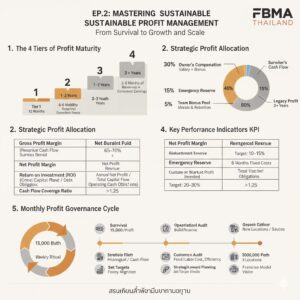
## The Four Tiers of Profit Maturity
### Tier 1: Survival Profit
**Focus:** Achieving positive cash flow to cover all costs and owner’s livelihood.
**Timeline:** Months 0-12
### Tier 2: Stability Profit
**Focus:** Building 3-6 months of operational reserves and consistent monthly earnings.
**Timeline:** Years 1-2
### Tier 3: Growth Profit
**Focus:** Generating surplus capital to fund expansion, new concepts, or major upgrades.
**Timeline:** Years 2-3
### Tier 4: Legacy Profit
**Focus:** Creating systems that generate profit independent of the owner, building enterprise value.
**Timeline:** Year 3+
## A Strategic Framework for Profit Allocation
When profit arrives, discipline it into five distinct funds:
- **Owner’s Compensation (30%):** A fair, regular salary and performance-based bonus.
- **Reinvestment Fund (40%):** For equipment upgrades, marketing, and new product development.
- **Emergency Reserve (15%):** Build a buffer equal to 6 months of fixed costs.
- **Growth Fund (10%):** Capital for new locations or business model expansion.
- **Team Bonus Pool (5%):** Share success to boost morale and retain top talent.
## Key Performance Indicators for Profit Health
Monitor these metrics monthly:
- **Gross Profit Margin:** `(Revenue – COGS) / Revenue` | **Target:** 65-70%
- **Net Profit Margin:** `Net Profit / Revenue` | **Target:** 10-15%+
- **Return on Investment (ROI):** `Annual Net Profit / Total Capital Invested` | **Target:** 20-30%+
- **Cash Flow Coverage Ratio:** `Operating Cash Flow / Debt Obligations` | **Target:** >1.25
## From Single Site to Sustainable Brand: A Case Study
**Concept:** “Heritage Noodle House”
**Year 1 – Survival:**
– Net Profit: ฿15,000/month
– All profit directed to building cash reserve.
– Focus on refining core operations and value proposition.
**Year 2 – Stability:**
– Net Profit: ฿40,000/month
– Implements the 5-Fund profit allocation model.
– Develops comprehensive Standard Operating Procedures (SOPs).
**Year 3 – Growth:**
– Net Profit: ฿80,000/month
– Uses Growth Fund to open a second, smaller-format location.
– Begins packaging signature sauces for retail.
**Year 4 – Scale:**
– Net Profit: ฿200,000/month (across 3 locations)
– Establishes a central kitchen for efficiency.
– Explores franchise model or licensed expansion.
## The Monthly Profit Governance Cycle
**Week 1: Financial Review**
– Analyze last month’s P&L statement.
– Reconcile cash flow.
– Set financial targets for current month.
**Week 2: Operational Audit**
– Scrutinize Food Cost % and Labor Cost %.
– Assess kitchen and service efficiency.
– Identify and eliminate waste.
**Week 3: Customer & Market Focus**
– Review customer feedback and sales data.
– Analyze competitor moves and market trends.
– Plan promotional and retention activities.
**Week 4: Strategic Forward Planning**
– Finalize plans for the coming month.
– Set ambitious yet realistic profit targets.
– Align short-term actions with long-term vision.
## The FBMA Thailand Conclusion: Profit is a Choice, Not Luck
Sustainable profit management is the result of deliberate design, not chance. Embrace these three principles:
- **Adopt a “Profit First” Mentality.**
Allocate your target profit *first*, then manage expenses to fit the remaining revenue.
- **Build Systems, Not Dependencies.**
Create processes that generate profit reliably, independent of any single person’s heroic effort.
- **Fuel Growth Through Intelligent Reinvestment.**
The best profit is profit strategically funneled back into strengthening and growing the business.
**Ask yourself each month:**
– Is this profit consistent, or an anomaly?
– Do I fully understand what drove it?
– Can this level of profitability be replicated and scaled?
– Is this profit making my business fundamentally stronger?
## Closing Thought: From Cook to Creator
The journey from a “restaurant that survives” to a “thriving restaurant business” is marked by a shift in perspective—seeing profit not as a *line item on a statement*, but as the *fuel for your future* and the *resource to build a legacy*.
It begins with survival (Break-Even).
It advances through disciplined management (Profit Governance).
It culminates in building something that endures (Business Legacy).
**FBMA Thailand**
*Part 2 of 2: The Discipline of Growth*
www.fbmathailand.com
*40 Years of Transforming Thai Kitchens into Sustainable Businesses*