
Chinese Tea: The Art of Tasting and Professional Brewing Methods
- March 22, 2026
- Beverage Knowledge, Marketing, Restaurant Management
- 6 mins read
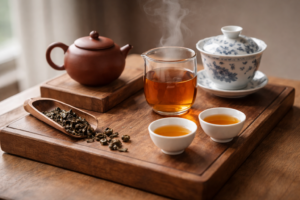
Chinese tea is far more than a beverage—it is a millennia-old civilization, a philosophy that fuses earth, sky, and human craftsmanship. From the legend of Shennong tasting herbs with tea leaves to the refined tea ceremonies of imperial courts, every step of Chinese tea production reflects exquisite subtlety and the accumulated wisdom of generations.
The Six Major Categories of Chinese Tea
Chinese teas are classified by their degree of oxidation and processing methods into six main categories:
- White Tea (白茶)
The least processed of all teas. Only tender buds and young leaves are selected, then naturally withered and dried. The liquor is pale yellow, with a delicate, sweet flavor and gentle aromas of fresh hay and faint florals. Famous varieties: Baihao Yinzhen (Silver Needle), Bai Mudan (White Peony).
- Green Tea (绿茶)
Unoxidized tea; heat is applied immediately after plucking to halt oxidation, preserving the fresh green character of the leaves. The taste is bright, grassy, or nutty, with a refreshing finish. Green tea accounts for the largest production in China. Famous varieties: Longjing (Dragon Well), Biluochun (Spring Snail).
- Oolong Tea (乌龙茶)
Partially oxidized, ranging from 10% to 70%. Oolongs offer a vast spectrum of aroma and flavor—from light and floral to deep and roasted—with a rich, complex body. Famous varieties: Tieguanyin (Iron Goddess of Mercy), Da Hong Pao (Big Red Robe).
- Black Tea (红茶)
Fully oxidized tea; the leaves turn dark reddish‑brown. The infusion is deep red, with a smooth, sweet, mellow taste, often carrying fruity or honeyed notes. Famous varieties: Keemun (Qimen Hongcha), Dian Hong (Yunnan Black).
- Yellow Tea (黄茶)
Similar to green tea but with an additional step: the leaves are lightly smothered and allowed to turn yellow (men huang). The result is a tea that is milder and less grassy than green tea, with a gentle, elegant aroma. Famous variety: Junshan Yinzhen (Junshan Silver Needle).
- Dark Tea (黑茶)
Post‑fermented tea, where microbial fermentation takes place over time. These teas can be aged for years, developing a deep, earthy, full‑bodied character. Famous varieties: Pu‑erh, Liu Bao.
Essential Teaware for Professional Brewing
The art of brewing requires proper tools that allow precise control over each variable.
Teaware | Function | Selection Notes |
Teapot (茶壶) | Brewing | Choose material to match the tea: Yixing clay for oolong and dark teas; porcelain for white and green teas |
Gaiwan (盖碗) | Individual infusion | Ideal for all tea types; allows precise timing and full aroma appreciation |
Tasting cup (品茗杯) | Drinking | Thin‑rimmed to enhance aroma delivery |
Fairness pitcher (公道杯) | Equalizing tea liquor | Ensures each cup has the same strength and flavor |
Tea needle (茶针) | Prying compressed tea | Essential for pu‑erh cakes and other pressed teas |
Tea strainer (茶漏) | Filtering leaf particles | Produces a clearer infusion |
Principles of Professional Tea Brewing
- Water Quality
Water is the solvent that unlocks a tea’s character. Professionals favor soft water such as natural spring or purified water. If using tap water, filter it and let it sit to reduce chlorine. Water temperature is the most critical factor:
- White tea: 75–85°C (167–185°F)
- Green tea: 70–80°C (158–176°F) — Longjing is best at 75–80°C
- Oolong tea: 90–100°C (194–212°F) — heavily roasted oolongs require full boiling water
- Black tea: 90–95°C (194–203°F)
- Yellow tea: 80–85°C (176–185°F)
- Dark tea: 95–100°C (203–212°F)
- Leaf‑to‑Water Ratio
A standard ratio is 1 g of tea to 20 ml of water (1:20). In gongfu style, a higher ratio is used (1:10 to 1:15) with very short steeps repeated many times.
- Steeping Time
Mastery of timing comes with experience.
Western‑style brewing (larger pot):
- White / Green tea: 2–3 minutes
- Oolong / Black tea: 3–5 minutes
- Dark tea: 4–6 minutes
Gongfu style (multiple short steeps):
- 1st steep: 15–30 seconds (often discarded as a rinse)
- 2nd–4th steeps: 10–20 seconds
- Subsequent steeps: add 5–10 seconds per steep
Professional Brewing Methods by Tea Type
Longjing Green Tea (Dragon Well)
Special technique: Use water at 75–80°C. Either pour water into the cup first and then add the leaves (xia tou fa), or pour water gently along the side of the vessel to avoid directly hitting the leaves, preserving the delicate chestnut aroma.
Steps:
- Warm the cup or gaiwan with hot water.
- Add 3 g of tea per 150 ml of water.
- Pour water at 75°C gently along the inner wall.
- Steep for 1.5–2 minutes.
- Re‑steep 3–4 times, adding 30 seconds each subsequent steep.
Tieguanyin Oolong (Iron Goddess)
Special technique: A quick rinse with boiling water awakens the leaves. Use fully boiling water (100°C) for the first proper steep, which should be very short (15–20 seconds) to yield a concentrated yet balanced infusion.
Steps:
- Place 7–8 g of tea in a 150 ml Yixing teapot or gaiwan.
- Pour boiling water over the leaves and discard immediately (rinse).
- Refill with boiling water, cover, and steep for 15–20 seconds.
- Decant into a fairness pitcher, then pour into tasting cups.
- Re‑steep up to 7–8 times, adding 5–10 seconds per steep.
Keemun Black Tea
Special technique: Use water at 90–95°C. Water that is too hot can cause bitterness and astringency. Pour decisively and avoid steeping longer than 3–4 minutes for the first infusion.
Steps:
- Add 3 g of tea per 200 ml of water.
- Pour water at 90°C over the leaves.
- Steep for 3–4 minutes.
- Strain or remove leaves; do not let them sit in the water.
- Re‑steep 2–3 times, increasing steep time to 4–5 minutes.
Pu‑erh Dark Tea
Special technique: Because pu‑erh is often compressed and fermented, two quick rinses are recommended. Use a tea needle to pry off the leaves carefully, always use fully boiling water, and keep initial steeps short to let the flavor unfold gradually.
Steps:
- Pry 5–8 g of tea from the cake (for a 150 ml vessel).
- Pour boiling water (100°C) over the leaves and discard immediately (first rinse).
- Pour boiling water again and discard (second rinse).
- Pour boiling water a third time and steep for 20–30 seconds.
- Re‑steep 10 or more times, increasing time slightly each round.
Professional Tea Tasting
Tasting tea professionally engages all five senses:
- Look (观色): Observe the liquor’s color, clarity, and intensity. Note the appearance of the infused leaves.
- Smell (闻香): Inhale the aroma three times: dry leaves, wet leaves after pouring water, and the scent left in the empty cup.
- Sip (品味): Take a small sip, allowing the tea to spread across the tongue. Identify flavor notes: sweetness, astringency, bitterness, and balance.
- Feel (感受): Notice the “body” or texture of the tea—its viscosity, smoothness, and mouthfeel.
- Aftertaste (回味): After swallowing, observe the lingering sweetness and fragrance that rises from the throat (huigan).
Common Mistakes to Avoid
- Unsuitable water: Hard water or water with chlorine destroys delicate flavors.
- Incorrect temperature: Over‑hot water scorches green tea; under‑hot water fails to extract the depth of black or oolong teas.
- Over‑steeping: Leads to excessive bitterness and astringency, muting desirable aromas.
- Insufficient leaf: Too little tea results in thin, uninteresting liquor.
- Skipping the rinse: Especially for oolong and dark teas, a rinse awakens the leaves and ensures cleanliness.
Conclusion
Professional Chinese tea brewing is a harmonious blend of science and art. Understanding the nature of each tea, choosing the right teaware, controlling temperature and timing, and practicing consistently—all lead to mastery.
As the saying goes: “In one cup of tea, there is coolness and warmth, sweetness and bitterness, life and spirit.” When we understand and respect the nature of the leaves, we unlock their true essence and experience the profound beauty of Chinese tea culture—a heritage passed down for thousands of years.
May every brewing be a meditation, and every sip a simple yet profound joy.
“Water is the mother of tea; the vessel is its father.”
水为茶之母,器为茶之父
“First brew, second scent, third taste, fourth lingering finish.”
一泡二香三品四回味