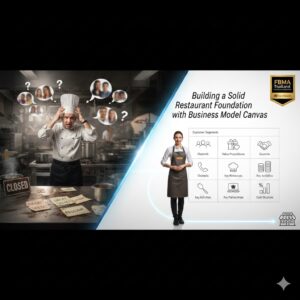
Building a Solid Restaurant Foundation with Business Model Canvas: Building a Solid Restaurant Foundation with Business Model Canvas: Insights from 40 Years of Expertise
- January 7, 2026
- F&B Service Operation, Marketing, Restaurant Management
- 3 mins read
By President of FBMA Thailand
In the saturated and highly competitive world of food service, relying solely on “great taste” or personal passion is no longer a guarantee for success. Through four decades of consulting and developing food businesses, we have learned that a systematic understanding of operations from the very beginning is the critical factor that separates sustainable establishments from those that shutter within a few years.
Today, FBMA Thailand introduces a powerful yet elegantly simple tool—the Business Model Canvas (BMC)—to help restaurateurs visualize their entire business model on a single page, before investing or revamping an existing venture.
What is the Business Model Canvas?
The BMC is a strategic blueprint that distills your business model into nine essential building blocks. It reveals how each part of your business connects and interacts, moving beyond a fragmented view to a coherent whole.
The 9 Building Blocks for Restaurants
- Customer Segments
Ask yourself: Who are you really cooking for?
- Move beyond “everyone.” Be specific: office workers aged 25–40 in Sathorn, suburban families in Bang Na, or tourists seeking authentic Thai street food experiences.
- Our observation: Restaurants trying to please “everyone” often end up resonating with no one.
- Value Propositions
Ask yourself: Why would customers choose you?
- This is the heart of your restaurant. It could be “homemade recipes passed down through generations,” “premium ingredients at accessible prices,” “an unforgettable dining experience,” or “speed and convenience.”
- Tip: Focus on 1–2 core values and excel at them.
- Channels
Ask yourself: How will customers discover and access you?
- Think beyond physical location: Grab/Foodpanda, Instagram Reels, your own website, LINE OA for reservations, corporate tie-ups, or even pop-up events.
- Key insight: Your channels must match the habits of your target customer segment.
- Customer Relationships
Ask yourself: How will you build and maintain connections?
- Personalized greetings, loyalty programs, active social media engagement, post-meal feedback requests, and community-building events.
- From experience: Returning customers are significantly more profitable than new ones.
- Revenue Streams
Ask yourself: Where does your money come from?
- Dine-in sales, delivery/takeaway, meal kits or retail products (e.g., signature sauces), catering, cooking classes, or event space rental.
- Crucial note: Always track Food Cost and Beverage Cost separately.
- Key Resources
Ask yourself: What assets are indispensable to your operation?
- People: Talented chef, skilled barista, front-of-house leader.
- Ingredients: Secret-recipe broth, ethically sourced meat, specialty imports.
- Place: High-visibility location, uniquely designed kitchen.
- Capital: Working cash flow.
- Key Activities
Ask yourself: What must you do repeatedly to keep the business running?
- Recipe R&D, daily market sourcing, staff training, content creation for social media, quality control, and financial monitoring.
- Key Partnerships
Ask yourself: Who do you rely on beyond your team?
- Suppliers: Local farms, specialty importers.
- Service partners: Delivery platforms, accounting firms, marketing agencies.
- Community: Food bloggers, neighboring businesses for cross-promotion.
- Cost Structure
Ask yourself: What are your major expenses?
- Cost of Goods Sold (ideally 30–35% of sales)
- Labor costs (25–30%)
- Rent and utilities
- Marketing and platform commissions
- Golden rule: Know every cost before setting your prices.
A Simplified Example
Concept: Premium Fresh Beef Noodle Shop
- Customer Segment: Health-conscious professionals aged 30–50, willing to pay for quality and transparency.
- Value Proposition: High-grade beef, clean preparation, traceable ingredients.
- Revenue Streams: Bowl sales, frozen meat packs for home cooking.
- Major Cost: Premium meat (up to 70% of COGS).
Conclusion: Four Decades of Learning
The Business Model Canvas is more than a paper exercise—it’s a structured thinking process that forces you to answer critical questions before you launch, or to honestly evaluate your current operation. Investing a few hours in refining your BMC can save you from costly mistakes and misguided efforts.
Long-term success in the restaurant industry doesn’t come from luck or a single secret recipe. It comes from intentional business design—a holistic, systematic plan where every piece fits together. Start building that foundation today.