The Art and Science of Food Cost: Mastering the Hidden Heartbeat of Your Restaurant By FBMA Thailand Food & Beverage Management Association
- January 8, 2026
- F&B Service Operation, Marketing, Restaurant Management
- 5 mins read
The Art and Science of Food Cost: Mastering the Hidden Heartbeat of Your Restaurant
By FBMA Thailand
Food & Beverage Management Association
In the kitchen of every truly successful restaurant, beneath the sizzle of pans and the aromas of exquisite cuisine, lies a quieter, more disciplined rhythm: the meticulous calculation and control of food costs. A profound truth governs our industry: **You can be the world’s most talented chef, but if you cannot master your food cost, you will fail as a business owner.**
The Business Model Canvas (BMC) reframes food cost from a mere spreadsheet figure into a vital component of your business ecosystem. It is intrinsically linked to your **Value Propositions**, your **Key Resources**, and your **Key Activities**. True food cost control is not about scarcity or cutting corners; it is about designing a system where every baht invested in ingredients is transformed into maximum value for your customer and sustainability for your business.
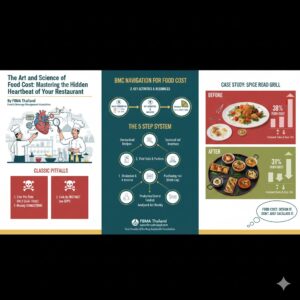
## The Classic Pitfall: When Food Cost is a “Scary Number,” Not a “Strategic Compass”
Most restaurants stumble over these fundamental misunderstandings:
- **”We only calculate cost per plate”** – forgetting to factor in the **Yield** (usable portion) of ingredients. Example: Purchasing 1kg of meat for ฿300, but after trimming and cooking, only 600g remains. The true cost is ฿500 per usable kilogram.
- **”We cook by instinct”** – lacking **Standardized Recipes**, leading to inconsistent flavor and wildly fluctuating costs.
- **”We miss the connections”** – failing to see how one menu item impacts the cost of another through poor inventory management and waste.
## Using the BMC as Your Navigation System for Food Cost
### 1. Start with Value Propositions & Customer Segments: Align Cost with Perceived Value
Each restaurant archetype has a different optimal food cost range, dictated by its promise to customers:
* **Premium / Fine Dining:** Food Cost may be **25-30%**. The value lies in the experience, presentation, and premium ingredients.
* **Casual Dining:** Food Cost should target **28-35%**, balancing quality with clear value.
* **Fast Casual / QSR:** Food Cost often needs to be below **30%** to maintain profitability at high volume and fast turnover.
**The Mistake:** Setting arbitrary food cost targets without linking them to the specific value your customer segment expects and is willing to pay for.
### 2. Key Activities & Key Resources: The Engines of Your Cost
* **Activities You Must Systemize:**
* **Standardized Recipe Development:** Precise, gram-weighted instructions for every dish.
* **Yield Testing:** Calculating the exact usable yield of every core ingredient after prep (peeling, trimming, cooking loss).
* **Rigorous Inventory Management:** Consistent weekly or bi-weekly counts to track usage and identify issues.
* **Essential Resources:**
* **People:** Kitchen teams trained to execute standardized recipes faithfully.
* **Tools:** Digital scales, portioning tools, and cost-management software.
* **Partnerships (Key Partners):** Suppliers who provide consistent quality at fair, predictable prices.
### 3. Cost Structure: Categorize with Clarity
Food cost belongs squarely under **Variable Costs**, fluctuating with sales. The correct calculation is:
`Food Cost % = (Cost of Goods Sold / Total Food Sales) x 100`
**Critical Rule:** Never hide spoilage or shrinkage within your food cost. Track these losses separately as they point directly to operational problems needing specific solutions.
## The 5-Step System for Masterful Food Cost Control
### Step 1: Create the “Source of Truth”: Standardized Recipes & Costing Cards
Every menu item requires a document detailing:
* Every ingredient (by precise weight/volume).
* Each ingredient’s current price per unit.
* Total ingredient cost per single serving.
* Ideal selling price (based on your target food cost %).
### Step 2: Conduct Yield Tests & Set Ironclad Portion Sizes
Test all primary ingredients to determine the **Edible Portion (EP)**. Establish and enforce exact portion sizes using scales or measured utensils.
### Step 3: Master Purchasing & Receiving
* Provide suppliers with clear **Product Specifications (Specs)**.
* **Inspect every delivery** against the order invoice, checking weight, count, and quality.
* Update your Recipe Costing Cards immediately with any price changes.
### Step 4: Implement Kitchen Production Control
* Produce based on **accurate sales forecasts** to minimize over-preparation.
* Enforce a strict **First-In, First-Out (FIFO)** system in all storage areas.
* Log and analyze **kitchen waste** daily to identify patterns and leaks.
### Step 5: Analyze and Act: The Weekly Ritual
Calculate your **actual food cost percentage** weekly or monthly using this formula:
`Food Cost % = [(Opening Inventory + Purchases) – Closing Inventory] / Total Food Sales x 100`
**When the numbers are off,** diagnose systematically: incorrect portioning, unrecorded waste, theft, or sales reporting errors.
## Case Study: Applying BMC Thinking to Solve a Food Cost Crisis
**The Problem:** “Spice Road Grill” saw food costs soar to 38% against a 32% target, despite stable sales.
**BMC Analysis Revealed:**
- **Customer Segments:** The primary clientele had shifted to groups of friends focused on drinks, ordering many small plates but finishing little.
- **Value Proposition:** The real offering was becoming ‘great food for sharing over drinks,’ not ‘a destination culinary experience.’
- **Key Activities:** The kitchen was still preparing large-portion, dine-in-focused plates.
- **Cost Structure:** High food cost was driven by waste from oversized portions that didn’t match the new customer need.
**The Strategic Pivot:**
* Refined the **Value Proposition** to “Exceptional, Shareable Plates for Social Dining.”
* Redesigned **Key Activities:** Reduced standard portion sizes by 25% while improving presentation for sharing.
* Adjusted **Revenue Streams:** Created curated “Social Feasting” sets at a compelling price point.
* **Result:** Food cost fell to 31%. Customer satisfaction increased as tables could sample more dishes without guilt, and total sales rose due to higher order variety.
## The FBMA Insight: Food Cost is an Art of Design, Not Just a Science of Restriction
The most effective food cost control begins when you stop viewing it as a “financial problem” and start seeing it as the “natural outcome of your business design.”
The Business Model Canvas shows us that your optimal food cost is defined by:
* The specific **Value** your customers choose to pay for.
* The **Activities** you must execute flawlessly in your kitchen.
* The **Resources** and **Partnerships** worthy of investment.
* The **Customer Relationships** you are building.
Do not merely **calculate** your food cost. **Design** it intentionally, in harmony with the business model you are building.
A sustainable restaurant is one where every baht spent on food is fully transformed into tangible value and memorable experience for the guest—a baht that then faithfully returns to the business as stable, reliable profit.
**FBMA Thailand**
Food & Beverage Management Association
Four Decades of Building Sustainable Foundations for Thai Hospitality
www.fbmathailand.com