
Building Restaurant Foundations with Business Model Canvas: Sustainable Cost Management & Revenue Design
- January 8, 2026
- F&B Service Operation, Marketing, Restaurant Management
- 3 mins read
By FBMA Thailand
Food & Beverage Management Association
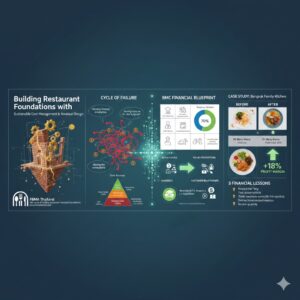
In the restaurant industry—where 60% of establishments close within their first three years—the critical question isn’t merely “How well will we sell?” but “How will we survive and grow?” A strong foundation begins with a systematic understanding of the relationship between revenue and costs. The Business Model Canvas (BMC) is more than a planning tool; it is a financial blueprint that reveals the bigger picture and helps design a business built to last.
The Cycle of Failure: When Revenue and Costs Fall Out of Balance
The most fundamental issue we observe in failing restaurants is:
- Viewing revenue in isolation – Focusing only on total sales without understanding the profit margin of each menu item.
- Seeing costs as one lump sum – Failing to distinguish between fixed and variable costs, leading to flawed decisions.
- Missing the connections – Not recognizing how a decision in one area impacts another.
The BMC solves this by linking all nine building blocks together, especially from a financial perspective.
Analyzing Costs Through the BMC Lens
- Cost Structure – Seeing Costs in Three Layers
Restaurants that manage costs well distinguish between:
Layer 1: Variable Costs
- Food and beverage ingredients (ideally 28–35% of selling price)
- Packaging for delivery/takeaway
- Commission fees to delivery platforms (Grab, Foodpanda)
Layer 2: Semi-Variable Costs
- Labor costs (increase with sales but not in direct proportion)
- Utilities linked to production volume
Layer 3: Fixed Costs
- Rent
- Manager salaries
- Equipment depreciation
- Basic utilities
FBMA Insight: Restaurants that survive crises typically keep fixed costs below 30% of total expenses.
- Key Activities & Resources – What Drives Your Costs
- Cost-generating activities: Recipe development, sourcing, staff training
- Essential investments: Skilled chefs, quality kitchen equipment, good location
Key question: Do these activities and resources create value that justifies their cost?
Designing Sustainable Revenue with BMC
- Revenue Streams – Beyond Just Selling Food
Modern restaurants need multiple income streams:
Core Streams
- Dine-in revenue
- Delivery/Takeaway sales
Supplementary Streams
- Merchandise: Signature sauces, branded goods, specialty ingredients
- Services: Catering, cooking classes, private dining
- Partnership income: Commissions from wine or premium coffee sales
Passive Streams
- Space rental during off-peak hours
- Membership or subscription fees
Design principle: Core streams should generate at least 70% of revenue, while additional streams provide risk diversification and flexibility.
- Customer Segments & Value Propositions – Aligning Price with Perceived Value
Different customers pay for different values:
- Speed-focused customers: May pay extra for express service
- Health-conscious customers: Will pay more for organic ingredients
- Experience-driven customers: Value atmosphere and premium service
Common mistake: Pricing based solely on cost-plus, without considering the customer’s perceived value.
Connecting All Elements: The Role of Channels & Customer Relationships
- Channels – Each Has Its Own Economics
- Dine-in: High location costs but full profit margin
- Delivery platforms: Lower margin (15–35% less) but expands market reach
- Direct channels (Website/Line OA): Higher initial investment but full margin long-term
- Customer Relationships – Retention Costs Less Than Acquisition
FBMA data shows:
- Acquiring a new customer costs 5–7 times more than retaining an existing one
- Customers who return 5+ times spend 20–30% more per visit than new customers
Case Study: Integrated Cost & Revenue Management with BMC
Restaurant: “Bangkok Family Kitchen” (FBMA Consulting Client)
Before BMC:
- Relied solely on dine-in revenue
- Food costs reached 42% due to uniform ingredient grading across all menus
- 80-menu items created operational complexity
After BMC Redesign:
- Clear Customer Segments: Health-conscious professionals (60%), Families (40%)
- Adjusted Value Propositions: For professionals – healthy, quick meals; for families – quality dining in a warm atmosphere
- Reduced menu to 35 items with focused ingredient sourcing
- Added new Revenue Streams: Office meal prep delivery, family cooking kits
- Optimized Cost Structure: Food costs reduced to 33% without compromising quality
Result after 6 months: Profit margin increased by 18% with only a 5% increase in total sales.
5 Financial Lessons from Applying BMC in Restaurants
- Record not just numbers, but the “why” behind them – Every cost and revenue should link back to your BMC strategy.
- Always test financial assumptions – If you believe a customer segment will pay a premium, validate before major investment.
- Think medium-term (18–24 months) – BMC helps visualize how today’s decisions impact tomorrow’s outcomes.
- Define interconnected metrics – Look beyond total sales to contribution margins per segment and channel.
- Review and adapt quarterly – BMC is not a one-time document but a living map that evolves with the market.
Final Insight from FBMA Thailand
Building a sustainable restaurant isn’t about simply “cutting costs” or “boosting revenue”—it’s about designing a system where income and expenses exist in dynamic balance. The Business Model Canvas is the tool that lets you see that balance clearly, before you invest heavily or before it’s too late.
The strongest restaurants today aren’t the luckiest or the most unique—they’re the ones that deeply understand their own economics and have designed every element to work in harmony.
FBMA Thailand
Food & Beverage Management Association
40+ years of building sustainable restaurant foundations
www.fbmathailand.com