
Creating a Powerful Unique Selling Point in a Highly Competitive Restaurant Market Connecting Customer Persona and the Business Model Canvas From Differentiation to Repeat Choice and Sustainable Performance
- January 7, 2026
- F&B Service Operation, Marketing, Restaurant Management
- 3 mins read
By President of FBMA Thailand
Introduction: A USP Is Not an Idea—It Is a System
In today’s restaurant market, competition is no longer defined by who opens first, who offers more dishes, or who advertises louder.
Quality food, attractive design, and fair pricing have become baseline expectations, not differentiators.
The real competitive question is no longer:
“What do we sell?”
but rather:
“Why should customers choose us—again and again—over every other option available to them?”
A true Unique Selling Point (USP) does not emerge from creativity alone.
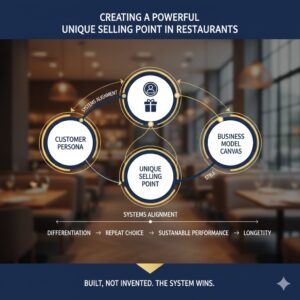
It is the result of systemic alignment between customer understanding, value creation, and business execution.
- Customer Persona: The True Starting Point of a Meaningful USP
A strong USP can never be designed in isolation.
Customer Persona represents a deep, practical understanding of the restaurant’s core guest—not just demographics, but real-life context:
- Daily routines and time constraints
- Decision-making triggers
- Emotional and functional pain points
- Expectations before, during, and after the visit
- Reasons for loyalty—or abandonment
Successful restaurants do not design USPs around what they are proud of.
They design them around problems customers are trying to solve in their everyday lives.
When the persona is clear, differentiation becomes focused, relevant, and defensible.
- USP as a Clear and Repeatable Value Proposition
From a strategic perspective, a USP is not simply “being different.”
It is a Value Proposition that customers immediately recognize as meaningful to them.
An effective USP must be:
- Relevant to the customer’s real needs
- Distinct from direct alternatives
- Deliverable consistently, not occasionally
If the core persona values reliability, speed, and peace of mind,
then elegance, menu size, or chef prestige may be secondary—or even irrelevant.
A compelling USP reduces decision friction.
Customers understand instantly why the restaurant fits their life.
- Business Model Canvas: Turning the USP into Reality
Many restaurants fail not because their USP is weak—but because their business model cannot support it.
This is where the Business Model Canvas becomes essential.
Key blocks that must align:
Customer Segments
Must directly reflect the defined persona—not a broad, unfocused audience.
Value Proposition
The USP must be clear, simple, and operationally feasible.
Key Activities
Kitchen systems, service workflows, and management routines must reinforce the USP daily.
Key Resources
People, suppliers, technology, and know-how must match what the restaurant promises.
Cost Structure
The cost base must support the value delivered—without hidden compromises.
A restaurant cannot promise consistency if its staffing model is unstable.
It cannot promise speed if its kitchen layout contradicts that goal.
A strong USP lives—or dies—inside the business model.
- From Differentiation to Performance: When the System Aligns
When Customer Persona, USP, and Business Model are aligned, the impact becomes measurable:
- Higher repeat visitation
- Stronger word-of-mouth
- Lower dependency on price promotions
- Faster decision-making at every management level
- A brand that grows through clarity, not noise
At this stage, USP is no longer a marketing statement.
It becomes an organizational compass guiding operations, hiring, pricing, and communication.
- Sustainability: The Long-Term Strength of a Credible USP
A modern USP must also be sustainable, not only appealing.
Sustainability in restaurants is not about slogans—it is about design:
- Menu engineering that minimizes waste
- Supply chains that are reliable and responsible
- Work environments that retain talent rather than exhaust it
A USP that damages margins, people, or resources will eventually collapse.
True sustainability strengthens trust—with customers, teams, and investors alike.
Conclusion: A USP That Endures Is Built, Not Invented
A powerful USP is not created in a single brainstorming session.
It is built through disciplined alignment between:
- Who the customer truly is
- What value genuinely matters to them
- How the business is structured to deliver it—every day
Restaurants that understand this do not compete on volume, price, or trend-chasing.
They win by becoming the obvious choice for a clearly defined audience—consistently, confidently, and sustainably.
That is how differentiation becomes performance.
And how performance becomes longevity.