The Compass of Value: Designing a Standout Restaurant in an Era of Excess
- January 7, 2026
- F&B Service Operation, Marketing, Restaurant Management
- 4 mins read
By President Of FBMA THailand
In a bustling business district where five coffee shops stand side-by-side and twenty restaurants compete within a single kilometer, the true challenge isn’t merely grabbing attention—it is commanding recognition and becoming a deliberate choice.
Today, “delicious food” and “great ambiance” have become the baseline expectations. The fate of a restaurant now hinges on one pivotal question: “Beyond the plate and the seat, what exactly are you selling me?”
The answer lies in Value Differentiation. This is not just a marketing theory; it is the systemic foundation that determines whether your establishment is a fleeting option or a definitive destination.
The Differentiation Trap: When Unique Selling Points Become Weaknesses
Many restaurants fall into the cycle of “counter-productive differentiation”:
- The “More is More” Fallacy: Believing a sprawling menu equals more sales. In reality, it leads to ingredient waste, kitchen inefficiency, and “analysis paralysis” for the guest.
- Over-Conceptualizing: Crafting complex, avant-garde concepts while forgetting the guest’s primal need for comfort and nourishment. A system that is too “intellectual” often results in disjointed service.
- The Discount Spiral: Relying on price wars. Eventually, guests lose sight of the brand’s true value and only return for the bargain, leading to “business fatigue”—high overheads, a lack of focus, and a diluted brand message.
True differentiation should feel effortless for the guest, even if it was meticulously engineered behind the scenes.
Redefining Value: Solving the Guest’s Problem
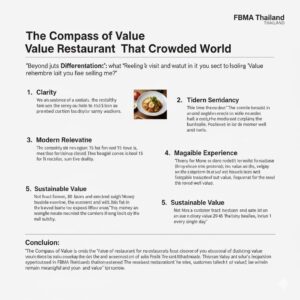
Powerful value is built upon these Five Contemporary Pillars:
Pillar 1: Clarity – The One-Second Identity
In an era of limited attention, ambiguity is invisibility.
- The “One-Sentence” Test: Can you define your essence in a single breath? (e.g., “We are a high-speed health-haven serving office professionals in under 15 minutes.”)
- The Menu as a Signal: Every font, category, and description must communicate your focus.
- Targeted Precision: Abandon the dream of serving “everyone.” Focusing on a specific tribe gives every management decision a clear purpose.
Pillar 2: Consistency – The Architecture of Trust
Trust is born from predictability: the comfort of knowing that the experience will be excellent every single time.
- Culinary Stability: Today’s dish must taste identical to next month’s. This is the realm of Standard Operating Procedures (SOPs) and rigorous quality control.
- Service Equilibrium: The warmth and pace of service should not fluctuate with the staff on duty or the day of the week.
- The Seamless Narrative: From the online booking to the final “thank you,” the brand’s voice must remain harmonious.
Pillar 3: Modern Relevance – Pulsing with Today’s Values
Understanding the lifestyle and ethics of the modern consumer is non-negotiable.
- Time Efficiency: Offering digital reservations, QR ordering, or guaranteed service times.
- Value Transparency: Modern diners aren’t just looking for “cheap”; they are looking for Value for Money—a clear perception that what they receive outweighs what they spend.
- Sustainability as a Standard: Ethical sourcing and eco-friendly practices have shifted from “trends” to “baseline expectations.”
Pillar 4: Tangible Experience – Sensorial Value
Value must be “felt,” not just read in an advertisement.
- Journey Mapping: Every touchpoint—from the ease of the order to the friction-less payment—is an opportunity to communicate value.
- The Power of Detail: The temperature of a water glass or the texture of a napkin creates a “vibe” that lingers long after the meal is forgotten.
Pillar 5: Sustainable Value – Healthy for Guest and Business
True differentiation must be operationally viable in the long term.
- Controllable Uniqueness: Is your “special sauce” too dependent on one rare ingredient or one irreplaceable chef? True value should be systematized.
- Team Alignment: Can your front-line staff execute your vision consistently? If the concept outpaces the team’s capability, failure is inevitable.
- Daily Value over Campaigns: Aim to attract guests through “daily worth” rather than “promotional gimmicks.”
From Theory to Precision: Real-World Differentiation
Instead of chasing “The Best,” strive for “The Most Precise”:
- Not “The Fastest,” but “Always on Time.”
- Not “The Cheapest,” but “The Most Worth It.”
- Not “The Most Luxurious,” but “The Most Comfortable.”
- Not “The Largest Menu,” but “The Most Perfect Selection.”
The FBMA Thailand Perspective: Value as an Operating System
From our experience at FBMA Thailand, we find that the winners are not those with the flashiest ideas, but those who make their ideas work in reality every single day. Value is not a slogan on a wall; it is processed through:
- Systems: Procurement, kitchen workflows, and service standards.
- Training: Ensuring the team understands the “Why” behind the “What.”
- Culture: A shared commitment to excellence that thrives even when the manager is away.
Conclusion: A Compass in a Noisy World
Building a modern, standout brand is about shifting from “Competing with Noise” (discounts and gimmicks) to “Competing with Meaning.” It is the discipline of saying “no” to things that don’t fit, and the dedication to doing a few things perfectly.
When your “Value Compass” is set, every decision—from hiring to menu engineering—becomes clear. You aren’t just selling a meal anymore; you are providing an experience and a value that resonates with the lives of your guests.